Verb estar to express emotions and moods
Verb estar to express emotions and states of mind Starting to learn a new language is quite a challenge. If you are reading this, we can say that you have a restless and curious mind. Learning a new language like Spanish is a wonderful adventure, so congratulations if you are here. By
Starting to learn a new language is quite a challenge, if you are reading this, we can say that you have a restless and curious mind.
Learn a new language like Spanish It's a wonderful adventure, so congratulations if you're here.
By the way, at the end of the post I leave you a little gift. 😉
One of the most poetic parts of learning a new language is the part in which we communicate emotions and feelings.
And learning is not only fully entering into the grammatical structure and logic of the language, but also see the way natives express phrases with emotions.
How do the Spanish do it?
There are many ways to study the way in which we Spaniards express our feelings.
We hear it in songs, we read it in books, we see it in movies...
And we cannot separate emotions from language. We are not robots! At least, not at the moment.
We are humans and as humans, we need to express what we carry inside, what makes us feel and move our hearts, even, why not?, the emotions that come to us when studying a new language.
They say that “without emotion there is no learning”. And this is totally true.
A good option to learn Spanish is through movies and series.
We all love spending time on the weekend, dedicating it to watching episode after episode of our favorite series of the moment.
Soaking up stories that will stay with us forever and that, without a doubt, make us feel what the characters themselves feel...
On our blog we have an article where we write tips with which we can improve our Spanish by watching movies and series. Study and enjoy at the same time, how wonderful!
In this article we talk about how to express emotions in Spanish. For this, we have a guest of honor: the verb estar.
This verb that you have heard and used so many times is one of those responsible for being able to convey in Spanish how we feel.
So, here we go! Let's start at the beginning.
What are emotional verbs
We have said that the verb be It is one of the responsible verbs, but it is not the only one.
The emotional verbs are those verbs that are used to do phrases of emotions and feelings. They serve to express everything that makes us feel a certain situation, a person or even something abstract.
We like to call them “verbs of feeling.”
And what are these emotion verbs in Spanish?
There are thousands, as many as there are feelings and emotions. In fact, sometimes you will see that it is not only a verb, we will find groups of words that help us explain well what emotion expresses what we are feeling.
For example, we can talk about being happy, excited, excited, angry, sad, worried... But also about being happy, nervous, sad, laughing...
These are some emotional verbs with examples:
I'm glad you can come to the party.
My grandmother is excited that I'm going to see her.
Julia finds it sad to watch dramatic movies.
It makes me laugh that you tell a joke.
As you can see, with these verbs we can wonderfully present how an emotion makes us feel.
Are you wondering how to express emotions in Spanish in a simpler way?
I explain it to you below.
verb be
The verb be in spanish It is one of our main verbs. In fact, it is one of the first verbs we learn when we start learning Spanish.
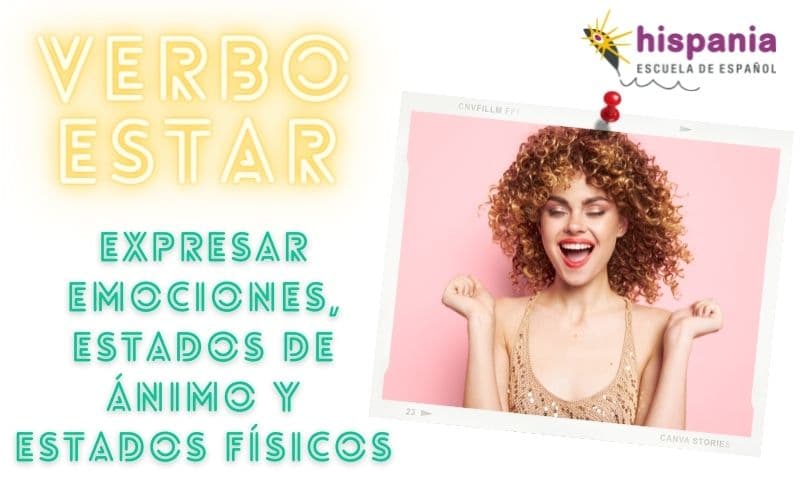
We can use the verb estar in many moments that we will see a little later, but for us today the one that interests us most is expressing feelings and emotions through the moods or the physical states.
The mood refers to a emotional feeling:
“EI'm happy because I'm going on a trip, I'm nervous because I have an exam…”
The physical state refers to a body feeling:
“We are tired or we are sick…”
Now that we know this...
What is the form of the verb estar?
If you don't know her already, here I present her to you.
And I present it to you with two different tenses so that you can express yourself freely.
one with the present and the other with him past imperfect, that is, with the past.
With the present you will be able to express feelings and emotions at this very moment. With the past imperfect tense, you can tell how you felt in a certain past situation.
Let's see the shape of the two strokes!
Present tense morphology of the verb estar
I explain the conjugation of the verb in the present:
| People | BE |
|---|---|
|
I |
I'm |
|
You |
are |
|
He/She/You |
this |
|
We |
we are |
|
You |
you are |
|
They/Them/You |
are |
Imperfect tense morphology of the verb estar
And here, the conjugation of the verb in the imperfect tense:
| People | BE |
|---|---|
|
I |
was |
|
You |
you were |
|
He/She/You |
was |
|
We |
we were |
|
You |
you were |
|
They/Them/You |
were |
Specific uses of the verb estar to express emotions, moods and physical states
As you see, theverb beIt has an easy morphology to remember, right?
In the present it is only irregular in the form of “I” and in the imperfect tense it is conjugated with the verb was.
However, we have the most interesting thing left to discover: What do we use this verb for? What are the uses of the verb estar?
Well then,It is used to talk about emotions, physical states andmoods in Spanish.
Basic structure: estar + adjective
To express both moods and physical states we will need to respect a very simple structure.
We will use the verbBEfollowed by aADJECTIVE.
The adjectiveWhat we will use should go in agreement with the subject who lives the emotion. So if the subject is feminine, the adjective will appear in the feminine form. If the subject is plural, the adjective will also be plural.
I'll give you some adjectives in Spanish with the verb estar:
I'm happy because I have got my place at the university. (The subject of “I am” is singular, therefore, the adjective happy is also singular).
Pablo's friends they are happy because they have passed the Spanish exam. (The subject of the sentence is “Paul's friends”, plural, therefore, the adjective will also be plural “happy”).
Alice she is worried, has lost the pendant that her grandmother gave her. (The subject of the sentence is feminine, thus, the adjective appears in the feminine “worried”).

Adjectives to express emotions in Spanish and moods
There are many ways to respond when a friend asks us:
“Hey, how are you?”
Generally we answer well or very well. It's right? Yes, it's perfect!
However, we can express feelings and emotions in many other ways without sounding repetitive: I'm great, wonderfully, fantastically, average (neither good nor bad), bad, pretty good / bad, super good / bad...
Furthermore, We can add adjectives that express more specific states of mind in Spanish.
Here are examples of emotions in Spanish with other adjectives: sad / happy, happy / unhappy, angry, worried, motivated, excited, upset, bored, surprised, upset...
We are excited because our team has won the cup.
Paula she is upset because she has broken up with her boyfriend.
Although remember, for Spaniards, the question “how are you?” or “how are you?” On many occasions it is a way of greeting. They are not expecting you to really explain how you feel using lots of adjectives with estar. It's kind of a courtesy question.
Adjectives to express states physical
The structure of the verb estar + adjective It also helps us to present how our body is at a certain moment. This is what we mean when we talk about “physical states.”
Some adjectives in Spanish that we can use to express how our body feels are, for example: sick / healthy, nervous / calm, dizzy, stressed, asleep, tired, strong.
Or sometimes we use expressions like: I'm in shape, I'm a kid, I'm fit as hell.
My grandfather is 100 years old, but he's made a kid.
Paula after getting on the roller coaster, she is dizzy.
Yesterday I didn't come because I was sick.
Below, we leave you an infographic as a list of emotions which will help you remember some vocabulary.

Activities to practice vocabulary
Now that you know a lot about how to express feelings and emotions, your moods and how your body feels, let's practice a little. Do you feel like it?
Fill in the gaps using these emotion words and the verb estar en present or in past imperfect.
IN LOVE - ANGRY - TIRED - HAPPY - NERVOUS - SAD
- Tonight I'm staying home, I've had a lot of work at the office, ¡ __________ __________ !
- When I went to school __________ __________ of a girl named Maria. He had long blonde hair. He also had eyes as blue as the sea.
- My brother and I get along well, now we never fight, but in the past we always __________ __________ over stupid things.
- I have an exam and although I have studied a lot, __________ __________ .
- When we were little, my friends and I played in the park and just for that reason __________ __________ .
- Before __________ __________ because I had heard a song of heartbreak.
Solutions
- I'm tired
- I was in love
- we were angry
- I'm nervous
- we were happy
- I was sad

How have the activities been? It sure is great!
In this article you have learned a lot of things: the morphology of the verb estar and the uses of emotions, some verbs of emotion, vocabulary of mood adjectives...
Surely now you can perfectly express your emotions in Spanish, like in the emotion drawings infographic above. What happiness!
Do you know that we also have adjectives that change meaning with ser and estar? Although that is another topic that we will see in another article.
If you want to continue learning and keep that restless mind reading and searching for information, you can come to our school Hispania, Spanish school and consult our face-to-face Spanish courses or do it online through our online Spanish courses.
You will learn all this that I explain to you directly and dynamically with colleagues from different countries. Interculturality is guaranteed.
Ah! And you will learn with fun, charismatic teachers with great knowledge of the language. Your oral expression and all Spanish communication skills will improve enormously, I guarantee it.
We are waiting for you in class or reading some of the useful articles on our blog.
Until next time 😊
PS: Here is the gift I promised you at the beginning: an activity so you can practice at home and with your friends.
Article written by Laura Cabrelles for Hispania, Spanish school
More articles