The 12 most used infinitive verbal periphrases in Spanish
The 12 most used infinitive verbal periphrases in Spanish Verbal periphrases are a fundamental part of Spanish grammar. Don't you know what a periphrasis is? Today we will explain what it is, how it is formed and we will focus on the 12 verbal infinitive periphrases that we use the most.
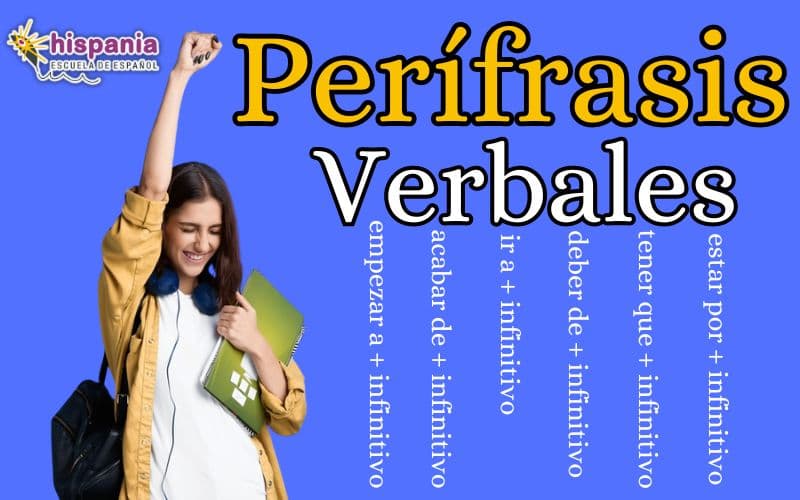
The verbal periphrases They are a fundamental part of the spanish grammar.
Don't you know what a periphrasis is?
Today we will explain what it is, how it is formed and we will focus on the 12 verbal infinitive periphrases that we Spaniards use the most.
You will learn to use them thanks to our theoretical explanation supported with examples and a final activity.
We assure you that these verbs are very common in everyday life, so if you learn them and introduce them into your language you will be doing your Spanish a great favor.
Would you like to delve deeper into the Spanish language at a general level?
So our spanish courses in Hispania, Spanish school They will be great for you 🤩.
Do you want to see what these are? 12 verbal infinitive periphrases most used in Spanish?
Well come on!
What is a verbal periphrasis?
If you frequently follow our blog, this question may sound familiar to you.
We have already talked about it several times in other articles.
A periphrasis is a verbal locution, or what is the same, a group of verbs.
This group is formed with a verb in personal way and another in non-personal way.
Remember that there are three non-personal forms of the verb: infinitive, participle and gerund.
Furthermore, there may be a conjunction or preposition between the two.
The structure would be like this:
Conjugated verb + Ø / preposition / that + infinitive / gerund / participle
There are many periphrases of different types.
Let's look at some examples of verbal periphraseswith the 3 non-personal forms.
- Periphrasis with infinitive: Start at + infinitive, finish at + infinitive, have to + infinitive, must + infinitive, be about to + infinitive, stay at + infinitive, etc.
- Participle periphrasis: Estar + participle, andar + participle, give for + participle, carry + participle, have + participle, follow + participle, etc.
- Gerund periphrasis: To be + gerund, to follow + gerund, to pass + gerund, to stay + gerund, to walk + gerund, etc.
These are some examples, but there are many more.
What are verbal periphrases for?
Periphrases work exactly like any verb. They are actions and each one has its own meaning.
Like all verbs, they can be conjugated in different tenses and verbal modes; present, past, future, imperative, subjunctive, etc.
As we do not want this article to take forever, today we are going to explain only the 12 most important periphrases with infinitive.
We will see their meaning, in what context to use them and practical examples.
Let's get to it!
Go to + infinitive
We already talked in depth about this verb in our article verbal periphrasis ir a + infinitive.
It is one of the most important periphrases in Spanish.
Indicates an action to be performed in the near future or as a safe plan What we will do in the future.
Examples:
- I'm going for a walk this afternoon.
- this summer is going to do safe heat.

Shutterstock Image
have to + infinitive
In the article ofexpress purposes in Spanish We talk a lot about this periphrasis.
It serves to express obligation or order.
Whenever we want to talk about duties or responsibilities that we must do, we use it.
It is one of the most used.
Examples:
- I have to study for tomorrow's exam.
- you have to order the living room before the guests come.
In simple conditional form, it can be used to give advice to other people.
- you would have to be more punctual so that they take you seriously.
There is that + infinitive
There is that + infinitive is similar to have to + infinitive.
Indicates a necessity or obligation.
The difference is that must + infinitive is impersonal, is used to speak in general or refer to something that all the people or all the subjects involved have to do.
Examples:
- you have to eat fruits and vegetables to be healthy.
- You have to be respectful of people.
Duty + infinitive
It's another obligation periphrasis, although less urgent that have to + infinitive.
Examples:
- I must carry some snacks at the birthday party.
- I must go in 5 minutes.
As with have to + infinitive, if we put the verb duty in the conditional it changes its meaning to express advice.
Examples:
- you should call To Ángel, you haven't spoken to him in a long time.
- you should go around here, it's a shortcut.

Shutterstock Image
duty of + infinitive
Oops! We have the same verb as before but with the preposition of. How curious!
Did you know that by adding this preposition the meaning changes completely?
In fact, it is a different verb.
duty of + infinitive is used to talk about probability or assumption.
Examples:
- Marcos hasn't arrived yet. It must be on the way
- I don't know why she's so angry. must have a bad day
Carry without + infinitive + amount of time or date
We continue to see more verbal periphrases with examples.
This verb expresses the amount of time someone has spent without doing an action.
Examples:
- ¿You haven't smoked 3 months? Congratulations!
- We haven't spoken since September.
stop + infinitive
This periphrasis marks the end of a habit What we used to do and now we no longer do.
Examples:
- I have stopped eating chocolate in the morning. It didn't suit me well.
- Navy has stopped looking the cell phone at night and now sleeps better.
Start to + infinitive
It is used to express that an action starts to be done or the beginning of a habit.
Examples:
- next month I will start to have practices at the driving school.
- Take the umbrella because it's starting to rain.
There are other periphrases like this, like begin to + infinitive or throw a + infinitive. These types of verbal periphrases are called periphrases inchoative.

Shutterstock Image
End of + infinitive
Talk about the conclusion of an action.
Examples:
- I have already finished writing the mail. Let's see when they answer me.
- When finish eating, call me and we'll meet.
Finish + infinitive
Although it seems similar to the previous verb, this verb has a different meaning, almost opposite in fact.
Indicates that an action it happened very recently.
Examples:
- Eduardo is fine. I just spoke with him, just a few minutes ago.
- Lucia just arrived. Let's give him his birthday gift.
Be about to + infinitive
It is used when something is in the imminent moment of occurrence. I mean, something is almost going to happen.
Examples:
- There are 2 minutes left until 18:00. The class is about to end.
- my bus is about to happen. The sign says he's next.

Shutterstock Image
To be + infinitive
This periphrasis shows indecision and at the same time willingness to do something.
It's when something is being considered, but it is not entirely clear.
Examples:
- I don't know what to do this afternoon. I'm about to go to the bookstore to see if I see any interesting books.
- Honestly, I don't like the tone you're using. I'm about to get up and leave
Exercises to practice
We have already seen the 12 infinitive periphrasis most used in Spanish.
After showing you these periphrases with examples, now it's time for you to practice them.
We propose you two exercises fast.
In the first, you must drag the conjugated verb from the right column to the space of the corresponding sentence, this way you will form the verbal periphrases.
In the next activity you have to do the same, but instead of dragging the conjugated verb, you have to drag the infinitive to its corresponding sentence.
Have they gone well?
The theme of Verbal periphrases are very important in the Spanish language, and we already told you that it is not going to stay here, but rather we will make more articles because there are many more to explore.
If you prefer to learn them in a class with a teacher, remember that we are at your complete disposal in Hispania, Spanish school.
Are there any of the explained periphrases that you don't understand well?
Would you like to know more about us?
If so, do not hesitate to ask in the comments and we will respond immediately.
Have a good day!
Article written by Carlos Martinez for Hispania, Spanish school.
More articles