
Imperfect preterite indicative: its forms and uses with examples
Imperfect preterite indicative: its forms and uses with examples We start November with enthusiasm! Therefore, in this article we are going to give you a gift. We are going to teach you the imperfect tense. 😊 What is past imperfect? It is a past tense. In Spanish we have four and this is
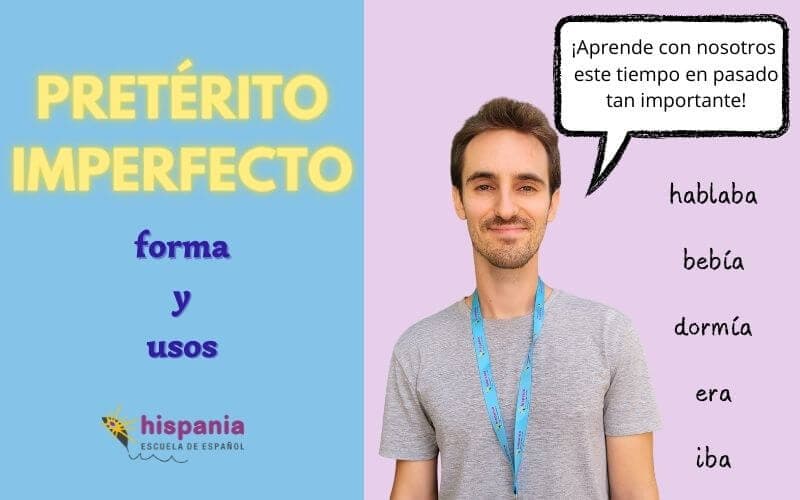
We start November with enthusiasm!
Therefore, in this article we are going to give you a gift.
We are going to show you thepast imperfect. 😊
What is past imperfect?
It's apast tense. In Spanish we have four and this is one of them.
We use it a lot and it is very important to learn it well.
Do you want to know how this time is formed and how it is used?
Let's go there!

Imperfect preterite of indicative: Form
The form of the past imperfect indicativeIt is very easy, both in theregular verbsas in theirregular.
You won't have any problems with this, you'll see! 😊
regular verbs
- Regular verbs that end in–AR, are conjugated with the ending–ABA.
- Regular verbs that end in–EReither-GO, are conjugated with the ending-IA.
Do you remember the music groupABBAand his songMamma mIa?
There you have a good trick tomemorize the form of the past imperfect. 😁
So that you understand it better, let's see thepast imperfectwith examples of averb of each infinitive:
| Person | AR (TALK) | ER (MOVE) | GO (WRITE) |
|---|---|---|---|
|
I |
spoke |
moved |
wrote |
|
You |
you spoke |
you moved |
you wrote |
|
He/She/You |
spoke |
moved |
wrote |
|
We |
we were talking |
we moved |
we wrote |
|
You |
you spoke |
you moved |
you wrote |
|
They/Them/You |
they spoke |
they moved |
they wrote |
Do you want to practice it with other examples?
I think it's great.
What would thepast imperfectof theverb walk?
With the termination-ABA, because the infinitive ends in–AR.
I was walking
you were walking
he/she/it was walking
we were walking
you were walking
they were walking
And thepast imperfectof theverb read?
As this ends in–ER, we put-IA.
I read
you read
he/she/it read
we read
you read
they read
In itnext exerciseyou will be ableconjugate thepast imperfectof theverb sing,the imperfect tense ofverb eatand the past imperfect ofverb sleep.
When you're done, we continue. I'll wait for you here. 😉
Solutions
verb sing
I sang
you sang
he/she/it sang
we sang
you sang
they sang
verb eat
I ate
you ate
he/she/it ate
we ate
you ate
they ate
verb sleep
I slept
you slept
he/she/it was sleeping
we slept
you were sleeping
they slept
Irregular verbs
Do you know how manyirregular verbsthere is in itpast imperfect?
Theirregular shapesThey always give headaches to Spanish students, but in this weather that won't happen to you.
Hepast imperfect irregularconsists ofthree verbs: the verbbe, the verbgoand the verbsee.
Only three!
It's fantastic, right?
| Person | BE | GO | SEE |
|---|---|---|---|
|
I |
was |
was going |
saw |
|
you |
you were |
you were going |
you saw |
|
He/She/You |
was |
was going |
saw |
|
We |
we were |
we were going |
we saw |
|
You |
you were |
you were going |
you saw |
|
They/Them/You |
were |
they were going |
they saw |
It was, it was and saw. Remember those words when conjugate the past imperfect of the verb to be, the imperfect preterite of the verb to go and the verb to see. The verbo see is considered semi-irregular since in reality it maintains the endings of verbs that end in -er and maintains the root ve-.
And what happens with the imperfect tense of the verb estar?
At times it is usually irregular.
Well, you're lucky, here the verb estar is regular: I was, you were, she was...
Oh my gosh, how easy!

Imperfect preterite of indicative: Uses
As you have seen, conjugate the verbs in the imperfect tense regular and their irregular It's not complicated at all.
Now let's see what the past imperfect.
Prepare well because this time has a lot of uses. 😀
Talk about an inaccurate past
A past not exact It means that we are talking about a non-concrete past, not specific in time. We don't know the exact moment. It doesn't matter when, but the action.
And how do we know when it is an inaccurate past?
For that we have the fabulous keywords:
- Before.
- In the past.
- When I was little/ when I lived in Argentina/ When I went to school…
- As a child/as a young man/as a child.
- In my grandparents' time...
- It's been a while.
Examples:
- I used to eat worse than now.
- In the past people did not have social networks.
- When I was little I played with my friends in the park.
Describe people, places, or situations in the past
This is a use of the past imperfect very relevant, since it is often used for description.
For describe people or places, the most common verbs are the following:
- To be – was
- be – was
- have – had
- Haber – there was
- Like – liked
- carry – carried
Examples:
- when it was little one, my father was very thin.
- Joseph before had a very slow computer. Now it has a more powerful one.
- In my old building there was few neighbors.
We can also use other verbs to describe a situation:
Example:
- At the party, the people came in and went out without stopping.
Talk about habits in the past
Another very important use is that of habits in the past.
They are actions that are repeated in the past, like a routine.
We also have keywords that express habits:
- Always/almost always.
- Many times / few times / sometimes.
- Often.
- Normally.
- Frequently / frequently.
- Every day / every day.
- On weekends / every Saturday.
- The verb soler (used to) + infinitive.
- Etc.
Examples:
- Before, when I finished my classes, always went home for snack.
- Last year, often you trained in the gym. Now you never go.
- A few years ago, Maria every day he woke up too early to go to work.
- you before you used to walkevery afternoon. Why don't you do it now?
Talk about the time an action happened
We also use this time to give emphasis to the time something happened.
This is often used by writers of novels or poetry because it gives it a more lyrical touch.
Example:
- It was eleven at night when a strange noise was heard in the house above.
Although it can also be used in everyday contexts. Really, we are giving a descriptive touch to time.
Example:
- It was 6:00 p.m. when class ended.
Talk about the age at which an action was performed
We can express the age in which a specific action was carried out.
Examples:
- When I was 17 years old, I finished my high school studies.
- When Marcos was 10 years old, one day he fell off his bicycle and hurt himself a lot.
We can also talk about a habit at that age.
Examples:
- When we were 20 years old, We went out a lot to party.
- When I was 12 years old, every weekend I went to the beach in summer.

Describe the weather at a time in the past
More descriptions?
Of course. 😀
The imperfect tense of the indicative It is the most detailed time of all.
You can also describe the weather from a moment in the past.
Examples:
- When I entered college, it was raining a lot.
- yesterday morning it was cold.
- After the rain, the sky it was clear completely.
Present the cause that moves an action
We use the imperfect preterite indicative to presentthe cause that originates an action in the past.
Do you know causal connectors?
There are many, I'll tell you some:
- Because.
- Because.
- Because
- Like (always goes at the beginning).
Better if we see them with some examples?
Of course!
Examples:
- He was late for the appointment because I couldn't find parking place.
- He was often silent because the teachers were very hard on him.
- How could I not go shopping, he sent his son.
Present an action that is in process and is interrupted by another more immediate action
Has it ever happened to you that you are at home studying with great concentration and suddenly someone calls you on the phone?
Oh! Your study has been interrupted.
Well he past imperfect can be used to express this. We call him the past imperfect interrupted.
It is always made up of two verbs:
- The action in process in the past – imperfect tense.
- The action that interrupts the past – past indefinite or past perfect.
The action that interrupts will be with past indefinite if it happens in a exact past.
On the contrary, we will use the past perfect when we talk about recent actions.
There are words to connect the action in progress with the action that interrupts. They are mainly the following:
- When
- And suddenly
- And then,
I show it to you with examples and this way you will understand it much better:
- Yesterday, when was going on the street, a dog he barked at me.
- this morning I prepared my breakfast and suddenly a birdhas entered through the window.
- The other day, drove along the road and then a rabbit crossed.
Do you see it? In the three examples there are two actions: the past imperfect as an action in process and the P. Indefinite or P. Perfect as an action that interrupts.
Ah! I forgot.
In the action in process it is also very common to use the form of estar + gerund in imperfect: was + gerund.
Examples:
- Yesterday, when I was walking On the street, a dog barked at me.
- this morning was preparing I had breakfast and, suddenly, a bird came through the window.

Activities to practice past imperfect
That's it for the uses of the imperfect tense in this article.
But, you know what?
There is still more. 😍
Do you want to know them all?
In Hispania, Spanish school, we offer spanish courses in person and online Spanish courses where will you learn ALL about the past imperfect.
We are one spanish school accredited by the Cervantes Institute and one of the most awarded in the world. You we guarantee quality teaching.
But the article does not end here.
Next, we suggest you practice the past imperfect with exercises of different types.
Enjoy them!
Tell me in comments how things went for you. 😉
Activity 1: fill in the gaps with sentences
In the next activity you must write the correct form of the imperfect tense of the verbs in parentheses.
Activity 2: text to complete
We raised the difficulty a little.
Nowyou have a text and you must fill in the gaps conjugating the past imperfect of the infinitives at the top.
In this exercise you work on descriptions, habits in the past and the interrupted imperfect.
Activity 3: images to talk about before and now
In this activity, we present to you two pairs of sentences: one in the past and another in present. You have to relate them correctly.
Solutions to activity 1: fill in gaps with sentences.
- I liked it
- you had
- we used to
- there was
- they studied
- They were
- did
Solutions for activity 2: text to complete.
- was
- lived
- was known
- wore
- was
- were
- had
- quarreled
- was called
- came in
- had
Solutions for Activity 3: images to talk about before and now
- In the time of our grandparents, cell phones did not exist / Nowadays, we cannot live without them.
- When Paula was 12 years old, she didn't play sports / Nowadays, she is quite an athlete.
- Before, my cat ate a lot of feed / Now she prefers to eat meat.
- Before, José practiced Judo / Currently he practices Capoeira.
- Years ago, Julián did not know how to speak other languages / Today; He speaks English, Spanish, Polish and Chinese.
- In the past, Lucía was very shy / Now she is very open and sociable.
- Before I didn't know how to drive / Right now, I can drive cars and motorcycles.
With these past imperfect exercises We are done for today.
I hope it has been very helpful to you and from now on you use this tense in your daily life.
A big hug!
Article written by Carlos Martinez for Hispania, Spanish school
More articles


